
I once stood on the road opposite Adelaide Arcade for more than an hour.
We were on a family trip to Adelaide. In the morning, as we walked past the front of the Arcade, an image flashed in my mind and held me. At the end of the day, after all the activities, the family went back to the hotel while I returned to that spot.
Adelaide Arcade was where I last met someone important. And I knew I had to take that photo—for closure.
The problem was that a van was parked outside. It was a loading zone, so I thought it shouldn’t take long.
But the workers must have been busy. So I waited, and I waited.
While the sun faded, and faded,
and the light softened across the front of the Arcade.
Eventually, the workers returned and the van moved. The traffic on the busy road cleared and the wind carried the flag over Adelaide Arcade into the right angle.
I clicked the shutter. One shot of film.
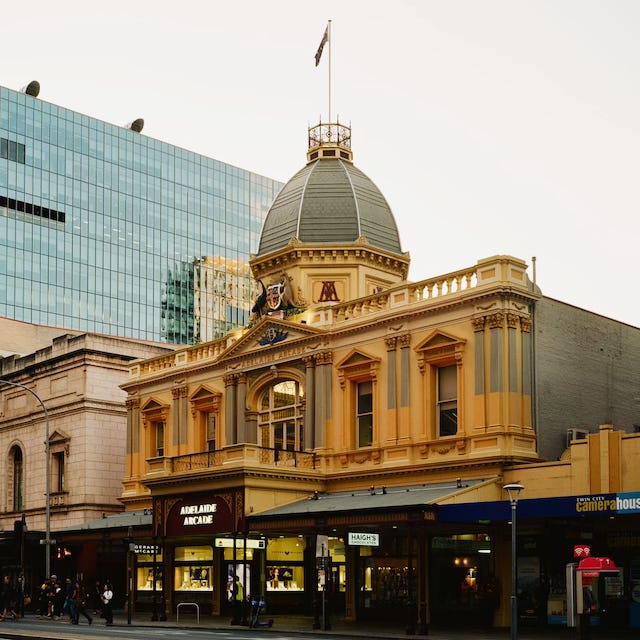
(Adelaide Arcade, Mamiya 6, Kodak Gold 200)
Photography is like that. Most of the work is not adding to the scene, but removing from it. I often spend time decluttering what is there, and waiting for someone, or something, to leave. My wife is used to it from our dating days. It is not unusual for a single photo to hold us up for fifteen minutes.
The point is that—the decision to exclude something is not the decision to include something else.
Think of a farmer over a field. The farmer’s constant task is to keep weeds out. Only then does it make sense to plant the crop in. It would be a confusion of categories to say the weeds were removed because the corn was planted.
Or, as I tell my developers: the hallmark of an elite developer is not an obsession with how the code works, but with anticipating how it could fail.
The idea that exclusion is a primary act is difficult for leaders.
For one thing, the skill of exclusion is often more elusive than deciding what to include. For another, because exclusion is invisible, it is hard to reward and easy to forget.
But most difficult of all, because excluding something is not the residual of including something else, there is a gap—a moment where things have been removed, but what replaces them is not yet decided.
In this gap lies the pain of uncertainty.
How many times have we seen leaders destroy what was working—not because of what they removed, but because of what they hurried to put in?
People are often surprised that we don’t have a TV at home. I sometimes say, half joking, “We never got one to begin with, and it never occurred to us that we needed one.”
But I don’t carry a phone either.
I don’t have home keys.
Or car keys.
Most of the time, I don’t even carry a wallet.
None of this is a consequence of deciding to carry something else. It had to be carefully designed—fingerprint locks on our doors, a car with keyless entry, a mobile setup that routes calls to my watch.
It took time, and in some cases years, waiting for the technology to reach a point where this could be done. These designs posed a lot of constraints on my choices.
Close colleagues sometimes remark that it is amusing to watch me swing between high-tech and low-tech. I laugh because it is true. But the deeper reality has always been the same: I was trying to exclude something.
And it is not because I am a “minimalist.” Like most people, my life is already more complicated than it needs to be. Minimalism, with three children, is not seriously thinkable.
I do it because what is excluded is part of what something is.
Looking back on years of leadership—mine and others’—much of the hardest work was not what we put in, but what we held out. And this is difficult to explain.
I have seen something beautiful change, and be lost, because what had been excluded could not be understood.
So yeah, it is important to look deeper, and learn to see that, as with a beautiful photograph, what is visible depends on what is invisible.